Captain’s Log Entry
The Hull Takes Shape
There comes a point in every build when the collection of parts on the bench stops looking like a collection of parts and starts looking like a ship.
Project Destroyer reached one of those points today.
A Proper Hull
The Tactical Pirate now has a clearly defined interface architecture built specifically around the little 320×170 display of the LILYGO T-Embed CC1101 Plus. Rather than continuing to bolt screens onto firmware and hoping navigation sorts itself out later, the Hull now owns the rules.
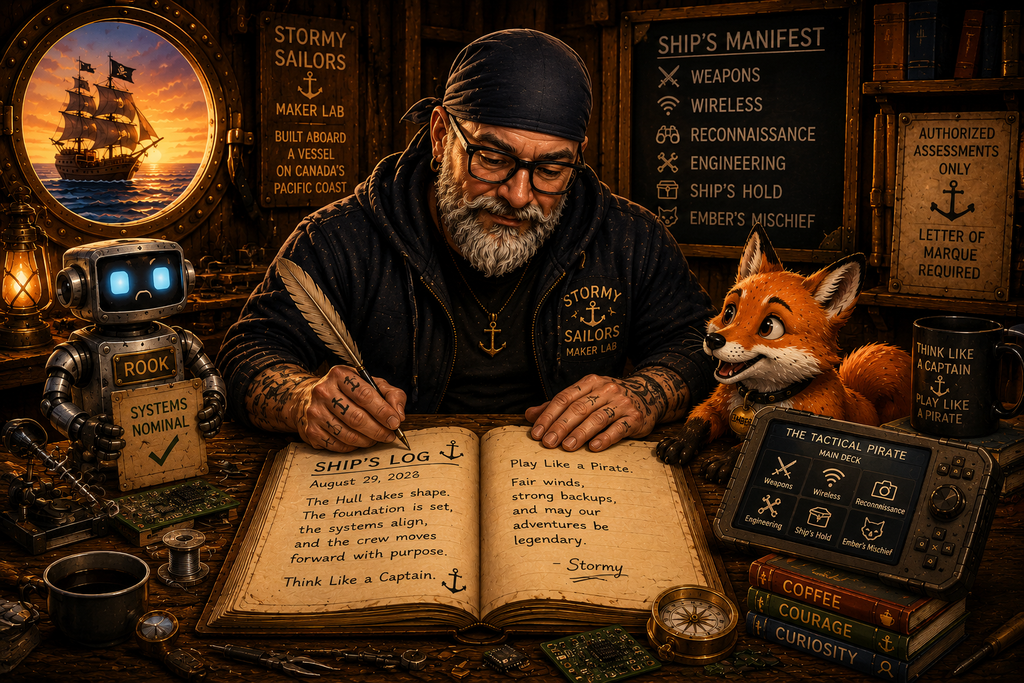
Boot leads to a restrained Landing / Ready screen. From there the operator enters the Main Deck, and the Main Deck becomes the starting point for the ship’s six departments: Weapons, Wireless, Reconnaissance, Engineering, Ship’s Hold and, naturally, Ember’s Mischief.
BACK, ACTION and MAIN now have defined jobs instead of being invented again by every screen. The goal is simple: wherever you are aboard the device, you should know how to get home without needing a chart, a compass and divine intervention.
No Ghost Equipment
One of the more important decisions was that the interface must know what hardware is actually aboard.
If a capability is fitted and commissioned, the firmware can offer it. If hardware is present but not commissioned, the system should say so. If it is absent or has failed, the operational interface should not pretend otherwise.
That matters as Project Destroyer grows. IR, NFC/PN532 and nRF24 support may all exist on different configurations, but the Tactical Pirate should never become one of those gadgets with a magnificent menu full of buttons that lead nowhere.
The Ship’s Hold
Storage is also getting a proper home. Ship’s Hold will become the common place for captures, evidence, exports and other material rather than allowing every department to invent its own little cargo locker.
The same thinking is going into updates and recovery. stormysailors.com is intended to become the official Tactical Pirate firmware port of call, backed by an offline SD-card recovery route for the day when networking, firmware or Murphy decides not to cooperate.
Letters of Marque
The authorization model is staying firmly aboard. Capabilities capable of disruptive active testing remain behind the Letter of Marque concept: powerful tools belong in an authorized assessment, not hanging loose in the menu waiting for an accidental button press.
And Bruce?
Bruce did useful service during the early exploration of this project, but Project Destroyer is now sailing under its own architecture. For the current capability-harvest work Bruce is explicitly out of the sourcing chain. Anything brought aboard from elsewhere has to earn its berth on licensing, engineering quality and fit with the Destroyer design.
Still Not Commissioned
And this is worth saying plainly: none of this means The Tactical Pirate is finished.
A successful compile is not commissioning. A gorgeous interface is not commissioning. A pile of features is definitely not commissioning.
The ship earns that word when the complete system works on the physical hardware, the controls behave properly, the fitted capabilities report honestly, recovery works, and an operator can move through the device without being trapped or misled.
Today we didn’t finish the ship.
We gave her a proper hull.
Think Like a Captain. Play Like a Pirate.