
Captain’s Log Entry
Return to Sea — The Beginning
“I was seventeen years old when I joined the Royal Canadian Navy. More than forty years later, I’m finding my way back to the water.
This time, I’m choosing the ship.”
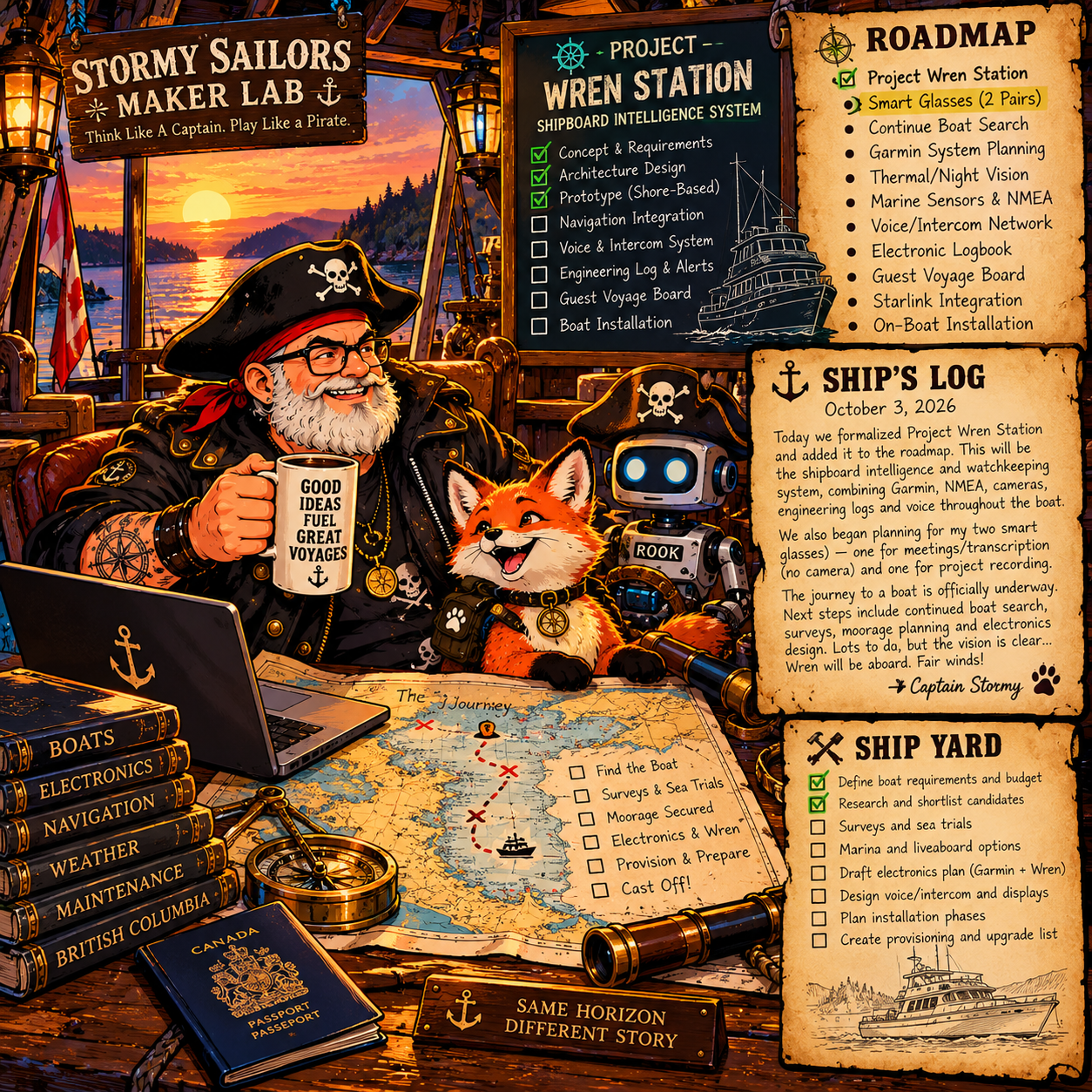
The Beginning
This is not really a story about buying a boat.
It is a story about getting back to the water.
I joined the Royal Canadian Navy as a teenager in 1982. The Navy became part of who I was, and the sea has never entirely left me. My service also left things behind that I would not fully understand until decades later.
More than forty years after I first put on a uniform, I have been diagnosed with PTSD and depression connected to my military service. I am now in treatment and rehabilitation. I do not intend to turn these pages into an account of the worst things that happened. Those details are mine. But the mental-health journey is part of this story, because it is part of why returning to the water matters.
Retirement arrived in 2026, and with it came a question I had not really had the luxury of asking for a very long time: What do I want the next part of my life to look like?
The answer keeps pointing west.
I want a boat. Not a weekend toy and not somebody else’s ship. I am looking for a coastal motor vessel that can become a home, a workshop and a way to explore the coast of British Columbia on my own terms. Something capable and comfortable, with enough character that I will probably spend an unreasonable amount of time improving perfectly functional systems.
That is where Stormy Sailors comes in.
The search has already begun. There will be listings that look better in photographs than they do in person. There will be surveys, engines, electrical systems, marina searches, moorage problems, budgets, negotiations, good ideas, bad ideas and probably a few ideas that begin with, “Wouldn’t it be cool if…”
One of those ideas already has a name: Wren Station.
Wren Station is the idea of building a genuine shipboard intelligence and watchkeeping system around the boat rather than simply putting an AI chatbot on a screen. Navigation awareness, radar and AIS contact monitoring, weather and passage information, engineering telemetry, maintenance records, an electronic logbook, the ship’s manuals and voice access throughout the vessel could all become parts of the same system. The conventional marine equipment remains in charge of the jobs it was designed to do; Wren watches, correlates, explains and keeps the Captain informed.
Eventually I want to be able to walk onto the bridge with a cup of coffee and ask:
“Wren, what the fuck is going on?”
And get a useful answer.
There is no boat yet. That is rather the point of starting this now.
I want Stormy Sailors to chronicle the whole thing: the search, the boats considered and rejected, the survey that eventually matters, finding somewhere to keep her, buying her, learning every system aboard, refitting what needs to be refitted, building Wren Station, and finally casting off.
I do not know which boat it will be yet. I do not know exactly where she will take me. For the first time in a very long time, that is part of the excitement.
But I’m going back to sea.
Follow Return to Sea
This is only the beginning. Future entries chronicling the search for the boat, the boats considered along the way, surveys, moorage, the eventual purchase, refit, life aboard and the voyages that follow will be collected in Return to Sea.
There may not be a boat yet — but the story has already started.