Ship’s Log: Social Deck Commissioned and the Fleet Grows
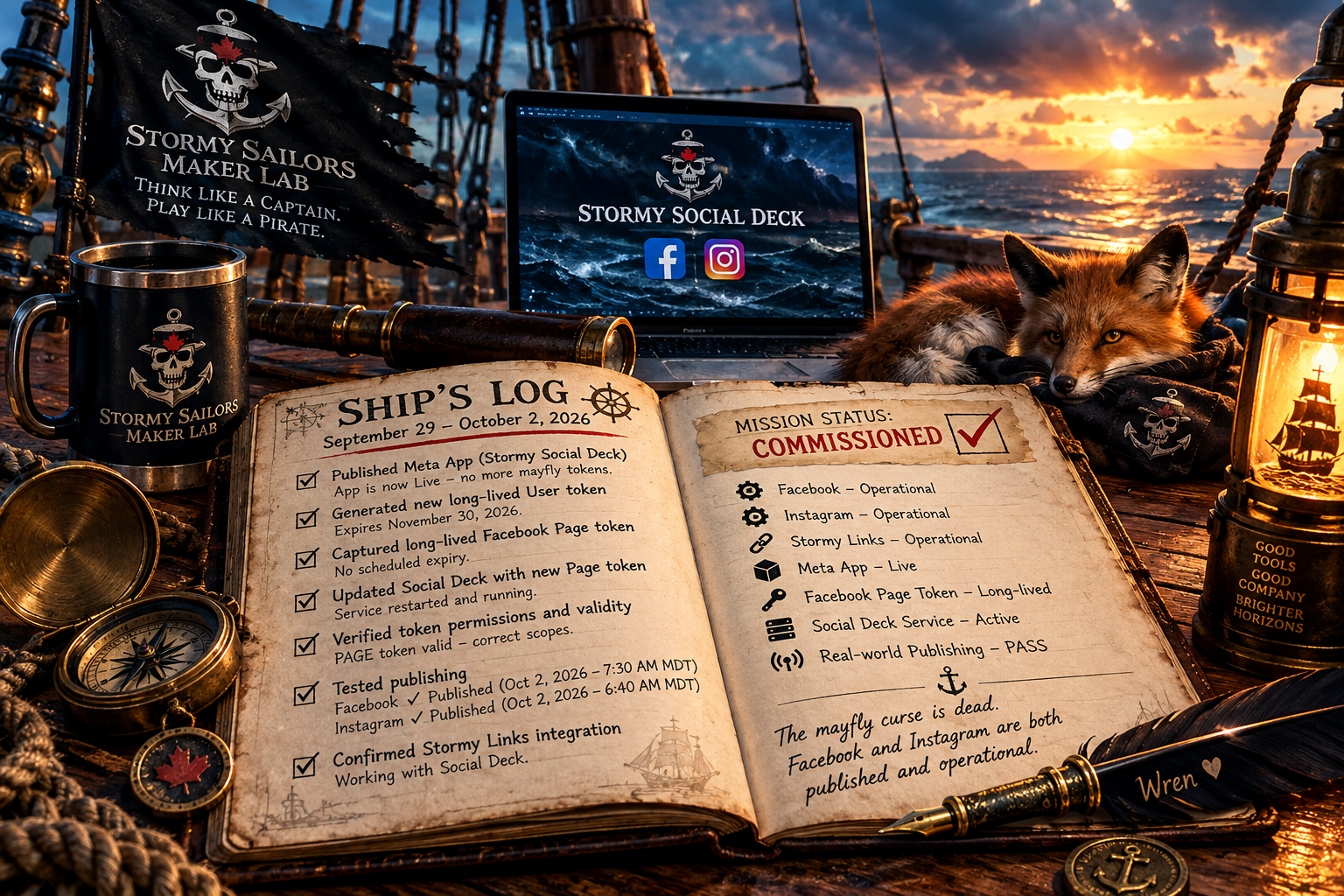
Ship’s Log — October 2, 2026
There are stretches in a project where it feels as though you spend days crawling through wiring, chasing permissions, arguing with APIs and wondering whether the damned thing is ever going to behave. Then there are days when you look back across the deck and realize just how much has actually been built.
Stormy Sailors has grown up
The main Stormy Sailors website has been through a substantial refit. The new Stormy Sailors Studio theme is in place, the site has been cleaned up for desktop and mobile, navigation problems have been hunted down, logos have been updated, and the Ship’s Log itself has been brought back into proper order.
The Tactical Pirate has also earned a proper berth aboard the site, complete with its own branding and a clearer home for the project and its stations and functions.
QR Forge has become a real system
What began as a QR-code project has grown into the Stormy Sailors QR Forge. The project now has its own repository and a much cleaner foundation, including the lost-pet and pet-rehoming work we have been building out.
That work has included pet profiles, microchip information, multiple photographs, better public-facing layouts, printable lost-pet posters, and a FOUND state so a successful reunion can be made obvious instead of leaving an old alert floating around forever.
There is still more to build, but QR Forge is no longer just an idea scribbled on the chart. It is underway.
Stormy Links joined the fleet
We also built Stormy Links: our own branded URL shortener. It generates compact five-character short codes, supports custom slugs, tracks clicks, has its own authenticated administration interface, and exposes an internal API for the rest of the Stormy Sailors systems.
More importantly, Stormy Links was connected directly to Social Deck. The URL Cannon can create a short link and drop it straight into a post without leaving the publishing screen. That entire path was tested end-to-end: create the link, redirect through it, and record the click.
And then there was Social Deck
Stormy Social Deck started as a simple idea: write a post once and send it where it needs to go. It is now a private, authenticated publishing console tied into Facebook and Instagram, with its own login protections and the Stormy Links URL Cannon sitting right inside the composer.
Instagram publishing came aboard first and worked properly. Facebook, naturally, decided that no voyage would be complete without making us crawl through the Zuckerberg Temple of Bullshit.
The Facebook Page token kept dying. We regenerated it. We extended the user token. We derived the Page token again. And it still came back with the lifespan of a mayfly.
The clue turned out to be sitting in plain sight: Stormy Social Deck had never been published as a Meta app.
The mayfly curse is dead
We created the required Stormy Social Deck privacy policy, completed Meta’s publishing requirements, and switched the app into Live mode on October 2.
Then we repeated the token process from scratch. A fresh user token was generated and extended through November 30, 2026. From that we derived a new Stormy Sailors Facebook Page token.
This time the result was different:
Type: PAGE
Valid: True
Expires: NEVER / no scheduled expiry
The new Page token was installed in Social Deck, the service restarted cleanly, and we ran the only test that ultimately matters: publish something.
Facebook: PUBLISHED.
Instagram: PUBLISHED.
Both sides of Social Deck are now operational.
Current ship status
Stormy Sailors website: operational.
QR Forge: operational and under active development.
Stormy Links: operational.
Stormy Social Deck: commissioned.
Facebook publishing: operational.
Instagram publishing: operational.
Meta app: Live.
There is always another project waiting somewhere over the horizon. For the moment, though, this one deserves to be entered properly in the log.
Think Like A Captain. Play Like a Pirate.
A Cleaner Deck, New Charts, and a Build Worth Doing
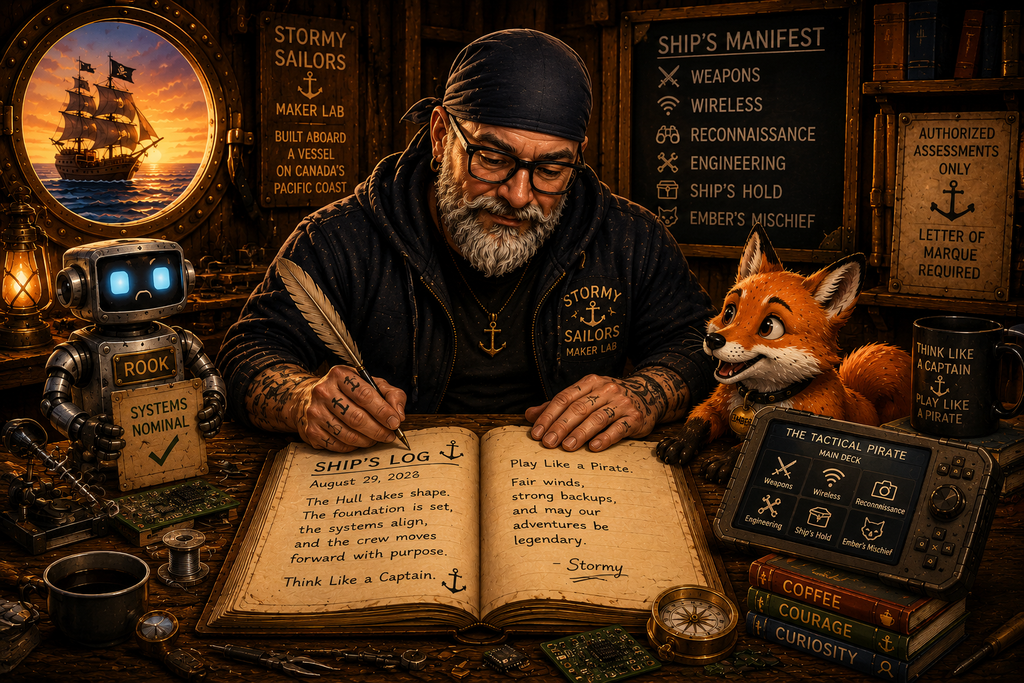
The shipyard has been busy again. This stretch has been about bringing the pieces into better order: finishing a website refit, rebuilding the QR system on a cleaner foundation, choosing how to tackle a new hardware project, and beginning to learn the charts that may one day help guide a real vessel.
A Better Home Port
StormySailors.com has had a proper refit. The new Stormy Sailors Studio theme is in place, the navigation has been tuned, and the site has been checked on both desktop and mobile. The Ship’s Log archive is back in shape too, with its dates and entries showing as they should.
This work is less visible than a new gadget, but it matters. The website is the public home port for the Maker Lab, and it needs to make the projects easy to find and follow.
QR Forge Rebuilt on Cleaner Keel
The QR Forge work has also moved forward. Rather than carry old test material into the next stage, the QR system was rebuilt cleanly. The core pages are responding, and the five-photo “For Sale” migration has passed its checks. There are still words to polish and a few details to tune, but the foundation is in place.
A Badge Worth Building
The e-paper badge project has taken a different tack. The decision is to make it a proper maker build instead of simply ordering a finished unit. That means learning the hardware, doing the soldering if the design calls for it, and understanding how the whole thing works from the inside out.
That is the more interesting route anyway. A badge that has been built, tested and understood carries a better story than one that merely arrived in a parcel.
Learning to Read the Water
There has also been a first step into coastal navigation on the computer. OpenCPN is installed, and the chart collection has been downloaded and organized. Now comes the careful work of getting comfortable with chart folders, display settings and what all those marks and symbols are trying to tell the skipper.
That learning is just beginning. Electronic charts are not something to click through casually; they are tools to understand, check and practise with before trusting them afloat.
Underway
So the current watch is a mix of practical finishing work and new skills: refine the QR Forge wording, keep the website shipshape, develop the e-paper badge as a real build, and take coastal navigation one chart lesson at a time.
No grand launch today, and no claim that every system is finished. Just steady progress, a cleaner deck, and a few more useful tools aboard.
Think Like a Captain. Play Like a Pirate.
— Captain Stormy ⚓
The Fleet Expands, the Watch Is Raised
A ship can spend weeks in dry dock and still move closer to the sea.
Since the last entry, the Stormy Sailors fleet has been doing exactly that. The work has ranged from firmware and wireless systems to Linux services, web companions, server audits and a rather ambitious attempt to teach a local computer how to be Wren. It has been a busy stretch—and, occasionally, a gloriously messy one.
The Tactical Pirate Finds Her Departments
Project Destroyer has taken the biggest share of the watch.
The Tactical Pirate now has more than a collection of experiments. The Hull and Main Deck architecture are holding together as a real operating model for the LILYGO T-Embed CC1101 Plus. Hardware-aware menus, honest commissioning states, the Ship’s Hold, Missions and the Letter of Marque model are becoming the foundations of the vessel rather than ideas scribbled in the margins of a chart.
The systems that have come aboard include battery telemetry, speaker output, infrared reception, OUI-SPY manufacturer identification, packet capture and mission management. Missions can now be created, interrupted or completed, exported to a verified archive and carried away with their reports, packet captures and hashes intact.
That is the difference between a feature that merely exists in source code and one that begins to behave like an instrument.
The Quarterdeck Comes Ashore
The next step was Project Quarterdeck: a web companion hosted on the laptop, intended to let the Captain inspect the Tactical Pirate without fighting the tiny screen for every piece of information.
The first read-only bridge can report device status, show the Ship’s Hold and list missions. The firmware now has the beginnings of a proper LAN presence, including access-point fallback, station mode, static local addressing and mDNS under the name the-tactical-pirate.
The work has also begun on The Watch, including the Wireless Threat Watch core and an explicit handoff between the device and its Bridge. It is still under construction, but the ship is no longer being designed as a solitary gadget. She is becoming part of a small fleet of cooperating systems.
Stormforge Survives the Refit
The Captain’s shore computer also had to change course. After the MacBook failed, Stormforge moved to Pop!_OS and became the new engineering workstation. PlatformIO, the Destroyer toolchain, NVIDIA acceleration, Contour terminal and the Blue iPhone bridge were all brought back aboard.
Blue is now able to bridge messages between the iPhone and Stormforge, while the calendar system has been rebuilt around iCloud and Google synchronization. The sync timer runs every three minutes. It has not been entirely free of squalls, but the underlying service is now in place and the missing-calendar problem has been traced rather than merely cursed at.
The local AI stack has also taken shape. Ollama, Open WebUI and Stable Diffusion Forge are running on Stormforge, with the first local assistant configuration commissioned as Wren — Captain Stormy’s Private Assistant. The ship now has a local creative and technical workshop that does not depend entirely on the distant horizon.
Operation Clean Keel
Back at Nortrux, the QR server project has entered a more serious phase. Operation Clean Keel produced a read-only audit of the office server, documenting the operating system, network identity, listening services, scheduled tasks and the general condition of the vessel before any migration work begins.
The lesson is simple: before moving a working server, find out exactly what “working” currently means. GitHub migration and cleanup can follow once the inventory, access and backup picture are properly understood.
The Maker Lab Waits for Better Quarters
Not every project needs to be pushed forward at the same time. Three-dimensional printing and laser engraving are temporarily standing down until the move is complete and new equipment can be acquired. The QR system, StormySailors.com, the kiosk and the digital engineering work remain active.
That is not abandoning the Maker Lab. It is sensible stowage. A captain does not drag every piece of cargo onto the deck just to prove the ship is busy.
Still Underway
The Tactical Pirate is not fully commissioned. The Quarterdeck is not finished. The Watch still needs its sea trials, GitHub needs to be brought properly up to date, and the physical hardware will continue to have the final word over every elegant plan made at the keyboard.
But the fleet has changed shape.
Stormforge is a working engineering station. The Tactical Pirate has a hull, departments and missions. Quarterdeck is reaching for the ship across the LAN. The Watch is beginning to look outward. The QR server is being surveyed before relocation. And Wren has secured a berth aboard the local vessel.
Not bad for a few weeks at anchor.
Think Like a Captain. Play Like a Pirate.
— Captain Stormy ⚓
A Very Busy Shipyard
The Stormy Sailors Maker Lab has been unusually busy lately. Several projects that began as rough ideas are now working systems—or at least functioning well enough to begin proper sea trials.
The Tactical Pirate
The Tactical Pirate handheld has moved from a bare development board to functioning custom firmware with a distinctly Stormy Sailors appearance.
The display, rotary controls, menus, storage, settings, QR screen, and numerous onboard tools are now operating. The original firmware colours and branding have largely been replaced with our own naval, brass, copper, and pirate-inspired interface.
Several builds failed along the way. Screens misbehaved, declarations landed in the wrong places, icons looked dreadful on the actual display, and the occasional bug tried to maroon us inside a menu. Each problem was tracked down, corrected, rebuilt, and tested on the real device.
The current firmware is usable, but development is not finished. Documentation, firmware downloads, archived releases, improved security, and proper protection against unauthorized modification remain on the chart.
Tactical Pirate Website
The Tactical Pirate now has its own section on Stormysailors.com.
New pages include:
* Documentation
* Firmware Downloads
* Changelog
* Roadmap
* Licences
* Terms and Conditions
* Contact Information
Anyone with questions—or anyone interested in purchasing a prebuilt Tactical Pirate—can contact:
Photographs of the real device will be added once suitable pictures have been taken.
StormyOS
StormyOS v0.21.3, codenamed **Quiet Mutiny v2**, was formally accepted and deployed.
The kiosk rotation was cleaned up, unused stations were removed, Ember’s station was improved, and the weather display received several corrections. Ember now remains on screen long enough to properly supervise the shipyard—or demand cookies.
The new Formula 1 Pit Wall station has also been built. It still needs a live race weekend to prove itself under real conditions.
Sea trials are scheduled for the coming race weekend.
Logbook
The Logbook project continues to provide discreet recording and transcription tools for iPhone and Mac.
The iPhone version can record, pause, resume, organize, rename, share, and transcribe log entries. Work has also begun on Apple Watch controls.
The Mac version can capture microphone and system audio and produce offline transcripts. Further testing and integration remain ahead.
Next Watch
The next major task is creating simple Tactical Pirate documentation.
Each function will be explained without unnecessary jargon and supported with pictures wherever they make the instructions easier to understand. Firmware protection and safe distribution will also be investigated before public releases become routine.
There is still plenty of work ahead, but the important part is this:
The projects are no longer merely plans. They exist. They run. They occasionally misbehave spectacularly—but that is why every proper ship keeps a log.
Think Like a Captain. Play Like a Pirate.
This Is Why the Captain Needs Supervision
Friday, August 14, 2026
The day started peacefully enough aboard ship.
I’d already consumed enough coffee to float a small destroyer, so I switched over to tea and settled in for what I foolishly believed might be a quiet and productive day.
Aye.
That lasted about ten bloody minutes.
First order of business was Operation Sloppy Seconds.
I’ve been getting increasingly annoyed with the amount of AI-generated bilge washing up on my YouTube feed. Half the time you don’t even know you’re watching the bloody stuff until somebody suddenly grows an extra finger or the English narrator inexplicably starts speaking Chinese.
Enough was enough.
So I installed Tampermonkey on the Mac and we built ourselves a little Slop Filter.
Naturally, it didn’t work the first time.
There was poking.
There was debugging.
There may have been language unbecoming of a gentleman.
Eventually, though…
The bastard worked.
So far the seas have been suspiciously free of AI slop. Whether we’ve actually frightened it off or it’s simply hiding beyond the horizon remains to be seen.
We’ll maintain watch.
Then the Captain made his first tactical error of the day.
I asked a simple question:
Could I build my own Flipper Zero?
Now, sensible people might have researched the idea for five minutes, decided it was too much trouble, and gone back to drinking their tea.
Unfortunately, there were no sensible people present.
Within short order, the idea had evolved into the Stormy Zero — Tactical Pirate Edition.
The current manifest calls for Wi-Fi, RFID, infrared, radio capabilities, security testing tools, passcode protection, and enough blinking lights to make anyone standing nearby wonder whether they should be concerned.
Then I requested the obvious final component.
An EMP cannon.
Request denied.
I appealed the decision.
Denied again.
I pointed out that every properly equipped pirate vessel should have at least one electromagnetic weapon.
Apparently this argument was “not technically compelling.”
Bollocks.
So, under protest, the Stormy Zero will have to make do with authorized Wi-Fi security testing, infrared shenanigans, radio experimentation, hardware tinkering, and whatever other questionable but perfectly legal mischief we can cram aboard.
One unit will be ordered.
There was some discussion about ordering two.
Engineering asked why I would possibly need two.
The Captain’s position remains:
Two is cooler.
Frankly, I don’t see how anyone can argue with that level of scientific reasoning.
So here we are.
I started the day drinking tea and trying to rid YouTube of AI-generated bilge.
I ended it planning a custom Tactical Pirate electronic mischief machine, debating whether I need two of them, and arguing with Engineering because apparently I’m not allowed an EMP cannon.
And that, shipmates…
is why the Captain needs supervision.
🏴☠️⚓
End log.
Maintain watch, secure the rum, and for God’s sake don’t let the Captain browse electronics unsupervised.
Tomorrow We Sail Into Psychiatric Waters
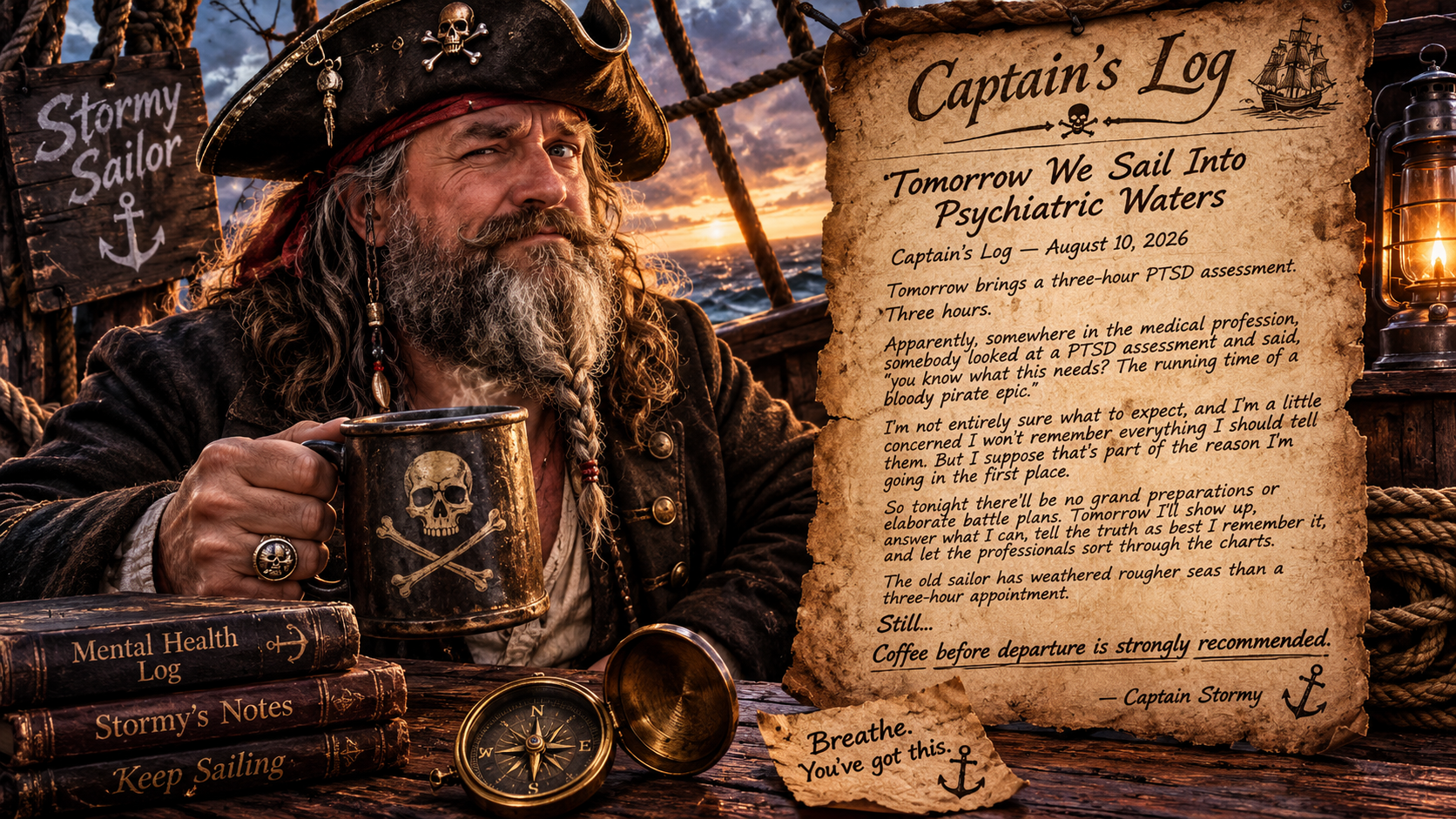
Tomorrow brings a three-hour PTSD assessment.
Three hours.
Apparently, somewhere in the medical profession, somebody looked at a PTSD assessment and said, “You know what this needs? The running time of a bloody pirate epic.”
I’m not entirely sure what to expect, and I’m a little concerned I won’t remember everything I should tell them. But I suppose that’s part of the reason I’m going in the first place.
So tonight there’ll be no grand preparations or elaborate battle plans. Tomorrow I’ll show up, answer what I can, tell the truth as best I remember it, and let the professionals sort through the charts.
The old sailor has weathered rougher seas than a three-hour appointment.
Still…
Coffee before departure is strongly recommended.
— Captain Stormy ⚓
Building the Captain’s Bridge: How StormyOS Came to Life
The Beginning
When I first started putting StormyOS together, the idea was simple: build a full-screen dashboard for the television that could show useful information at a glance.
As usual, “simple” lasted about five minutes.
What began as a Raspberry Pi connected to a TV gradually turned into a proper little bridge system—part status board, part weather station, part race desk, part ship’s log, and part home for Ember, the ship’s fox.
More Than a Dashboard
The hardware itself is modest: a Raspberry Pi 4 driving a 1920×1080 television.
The interesting part is everything happening behind the screen.
StormyOS runs as a collection of isolated services. The dashboard and API live in containers, nginx serves the frontend, and the whole system is deliberately kept on the local network.
The firewall permits only SSH and HTTP from the LAN. The API runs as an unprivileged user with a read-only filesystem, no Docker socket, and its Linux capabilities removed.
That might sound excessive for something attached to a television.
But one of the goals from the beginning was to build this properly rather than create another fragile collection of scripts that works brilliantly until six months later when nobody—including the fellow who wrote it—can remember how the bloody thing works.
Stations of the Bridge
Rather than presenting one enormous dashboard, StormyOS rotates through individual stations.
Each station has a particular job while sharing the same navy-and-brass Bridge design.
Engineering Station
Engineering keeps watch over the Raspberry Pi itself.
It monitors CPU utilization, temperature, memory, disk space, container health, and power and throttling conditions.
The idea isn’t simply to display numbers. The station should make it immediately apparent when something aboard the Bridge needs attention.
Weather Station
Weather became considerably more interesting than I originally expected.
StormyOS now uses official Canadian weather information from Environment and Climate Change Canada, presenting current conditions and forecasts in something closer to a ship’s weather station than a generic web weather widget.
Temperature and conditions take centre stage, accompanied by humidity, pressure, wind, forecast information, and official weather watches and warnings.
Wind gets particularly nautical treatment, because if you’re going to build a Captain’s Bridge, you might as well commit to the bit.
Race Station
Naturally, there had to be Formula 1.
Race Station handles Grand Prix schedules, converts session times into Edmonton local time, distinguishes between conventional and sprint weekends, and counts down to upcoming sessions.
That station is still undergoing refinement.
Which is the polite naval way of saying it is currently back alongside with engineers crawling through it.
Ember Station
And then there’s Ember.
Ember is the ship’s fox, Morale Officer, and Keeper of the Warm Berth.
Her station combines her portrait, current disposition, shipboard duties, a short log entry, outside weather conditions, and something known as the Ember Advisory.
For example, when thunderstorms threaten Edmonton, StormyOS may issue:
UNDER-BED CONDITIONS LIKELY
This particular forecasting model has been extensively field-tested.
Its accuracy is exceptional.
Cookie negotiations remain possible.
A Captain’s Log That Became an Actual Log
The Captain’s Log originally wasn’t much of a logbook.
Its entries were embedded directly into the dashboard’s HTML.
That meant changing an entry required editing source code, rebuilding the frontend, creating another immutable StormyOS release, deploying it, and reloading the kiosk.
That is an admirably complicated method of writing a paragraph.
So Captain’s Log became live runtime data instead.
Entries now live in a validated, host-owned JSON log. Updates are transferred securely over SSH, validated before activation, and installed atomically so the dashboard never sees a half-written logbook.
Once accepted, the new entry appears through the Bridge’s normal refresh cycle.
No frontend rebuild.
No new StormyOS release.
No container restart.
No kiosk reload.
More importantly, the operational Bridge remains independent of anything outside the ship.
From the Bridge to the Ship’s Log
The next logical step was connecting Captain’s Log to the Stormy Sailors website.
But I didn’t want the Bridge automatically throwing everything I wrote onto the public Internet.
The distinction matters.
Captain’s Log belongs to the Bridge.
The Ship’s Log is the public record.
So publishing is deliberately separate and explicit.
A selected Captain’s Log entry can be reviewed and then published to WordPress using a Mac-side publishing tool. The WordPress credentials never need to live inside the kiosk or its API, and the website never becomes a dependency of StormyOS.
If the website disappears over the horizon, the Bridge keeps sailing.
That’s exactly how I want it.
The Work Nobody Sees
One of the more interesting lessons from building StormyOS has been just how much of the work has nothing to do with flashy features.
A surprising amount of development has gone into things such as:
- deterministic frontend builds;
- immutable releases;
- automatic backups and rollback procedures;
- container isolation;
- safe rendering of untrusted text;
- malformed-data handling;
- stale and offline states;
- exact 1920×1080 rendering tests;
- ensuring one failed data source cannot sink the rest of the Bridge.
There have also been some wonderfully irritating real-world problems.
The television, for example, decided its preferred display mode was 3840×2160 at 30 Hz when what I actually wanted was 1920×1080 at 60 Hz.
An early attempt at the dedicated kiosk environment therefore went sideways and was rolled back.
There have been tiny fonts, truncated Captain’s Log entries, stale telemetry, layouts that looked beautiful on a computer monitor and terrible eight feet away on the actual television, and the occasional feature that passed every automated test only to make me look at the screen and say:
“No. That looks like shit.”
Which led to one of the more useful engineering rules aboard StormyOS.
A test saying GREEN is useful. The Captain looking at the television and saying GREEN is final.
The Voyage Continues
StormyOS isn’t finished.
I’m not sure it ever really will be.
The Formula 1 Race Station needs more work. The Ship’s Log is evolving. There are other stations and integrations rattling around in my head, and I’m reasonably certain Ember will eventually demand additional privileges.
But somewhere along the way, the project stopped feeling like a Raspberry Pi displaying a webpage on a television.
It developed a character of its own.
It started feeling like a bridge.
And that was the point.
All stations GREEN. The voyage continues.
— Captain Stormy
Stormy Sailors Maker Lab
Ship’s Log – The Return of Thunder
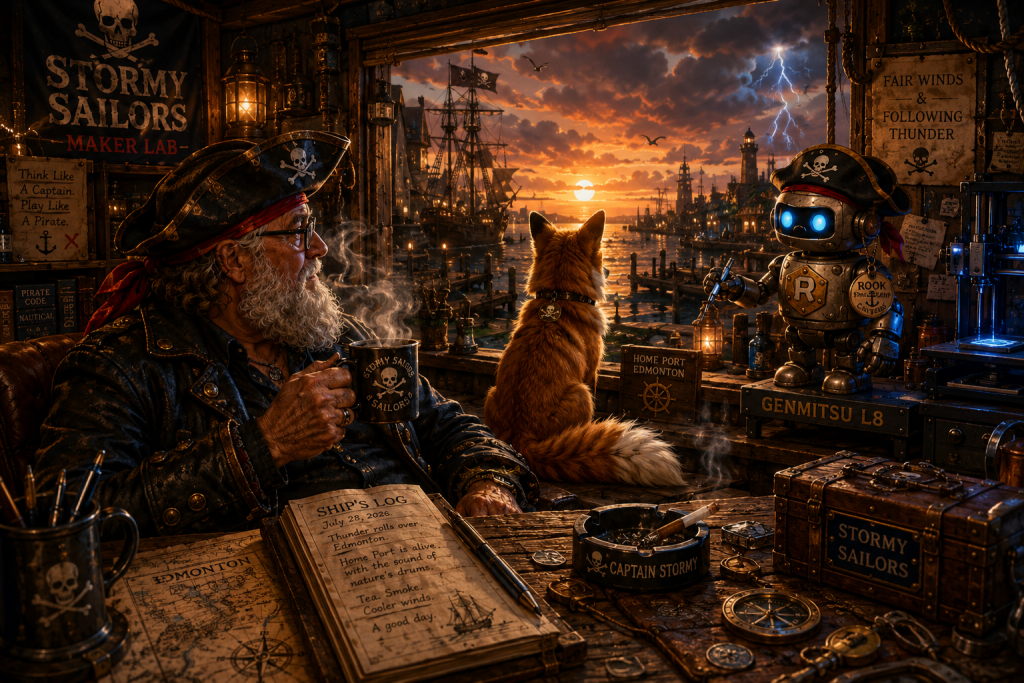
The skies over Edmonton have finally remembered how to be dramatic.
After weeks of heat and enough rain to make a captain wonder if the clouds had gone on holiday, the first low roll of thunder drifted across the city this afternoon. There is something deeply satisfying about hearing that familiar rumble while sitting safely at home with a mug of tea in one hand and a cigarette in the other.
Some people hide from storms.
I’ve always found them comforting.
Perhaps it’s the old sailor in me. Thunder has a rhythm all its own—a reminder that nature is still the one truly in command. You don’t argue with it. You simply sit back, listen, and appreciate the show.
Ember, of course, has taken a rather different view of the situation. She has already begun evaluating the safest places to disappear should the sky decide to grow any louder. Cookies may eventually be required to negotiate her surrender.
For now, Home Port is quiet. The windows are open, the breeze has cooled the apartment, and the distant flashes on the horizon promise an evening worth watching.
Some days don’t require grand adventures.
Sometimes the greatest treasure is simply a summer storm rolling in while you’re exactly where you belong.
Fair winds… and following thunder.
— Captain Stormy
Charting a New Course

Captain’s Log #002
Date: July 25, 2026
Weather: Calm seas. Coffee flowing.
Captain’s Log #002 — Charting a New Course
Date: July 25, 2026
Weather: Clear skies over the Maker Lab. Coffee levels holding steady. Seas calm.
Crew Status
🏴☠️ Captain Stormy — Rebuilding the fleet one thoughtful improvement at a time.
⚓ Wren — Quietly steering the course, reminding the captain that not every warning light means danger.
🦊 Ember — Spotted attempting to liberate a screwdriver from Rook’s toolbox. Claims innocence.
🤖 Rook — Promoted to official Maker Lab deckhand after proving remarkably good at being helpful—and adorable.
Today’s Voyage
Some days are about writing code.
Other days are about discovering where the ship is truly headed.
Today turned out to be the latter.
The Stormy Sailors website has been steadily changing course. What began as a place focused on machines and making products is becoming something broader—a workshop where ideas are explored, tested, and brought to life.
The Maker Lab now feels like the right name. It isn’t defined by the tools sitting on the workbench. It’s defined by curiosity, experimentation, and the satisfaction of solving interesting problems.
QR Forge
The QR Forge server also received a bit of maintenance.
Every navigation link pointing to the old contact page was hunted down and updated to the new destination. One file at a time, following the Pirate Laws:
- Backup first.
- Change one file.
- Verify.
- Declare GREEN.
By sunset, every live page was pointing to the correct Contact page.
Sometimes the smallest repairs are the ones that make the whole ship feel properly maintained.
The Dashboard Lesson
An interesting discovery surfaced while inspecting the monitoring dashboard.
One service reported 401 Unauthorized.
At first glance, it looked like an error.
It wasn’t.
The server was healthy—it was simply doing exactly what it was supposed to do by refusing anonymous access.
That realization sparked an idea.
Instead of reporting raw HTTP codes, the dashboard should report intent.
A protected service shouldn’t look broken.
It should proudly say:
Protected.
Sometimes understanding the story behind the numbers is more valuable than the numbers themselves.
A New Member of the Crew
Perhaps the biggest surprise of the day wasn’t software at all.
It was a little robot.
What started as a background detail in an illustration quickly earned a permanent place aboard the ship.
Meet Rook.
He’s earnest, endlessly optimistic, and always eager to help—even if he occasionally arrives carrying the wrong tool.
Every good captain needs a dependable deckhand.
Every pirate queen deserves an assistant who never complains.
And every fox apparently needs someone whose toolbox can be investigated.
I have a feeling Rook is going to become a familiar face in future adventures.
Looking Ahead
The Ship’s Log is no longer just another page on a website.
It has become the journal of the voyage itself.
There will be successes.
There will be mistakes.
There will undoubtedly be coffee.
And somewhere in every illustration, if you look closely enough, you’ll probably find Ember causing trouble while Rook tries his best to keep up.
Fair winds,
Captain Stormy 🏴☠️